Third Visit to the Canton Fair: JIAOKAI’s Braking Solutions Are Entering Industrial Sites Worldwide
2026
Guangzhou · China CANTON FAIR
Trade with the World, Mutual Benefit for All
CANTON Fair
Jiaozuo City Brakes Development Co.,Ltd.
The 140th Canton Fair CANTON FAIR
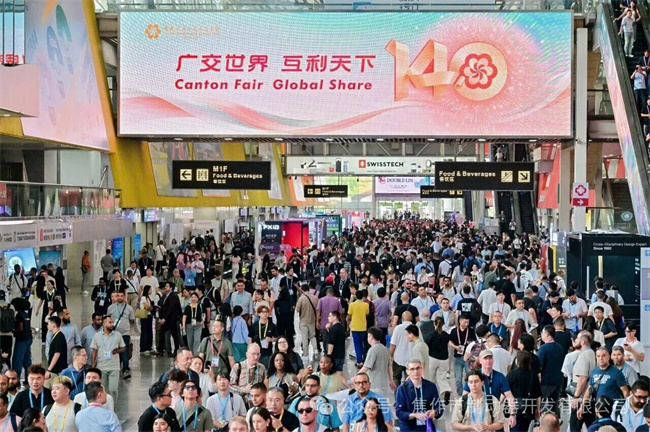
The 140th China Import and Export Fair (Canton Fair) opened in Guangzhou on October 15, 2026, with its first phase focusing on advanced manufacturing. Jiaozuo City Brakes Development Co.,Ltd. (“JIAOKAI” for short) is exhibiting for the third time, bringing not a single product but a complete braking solution covering seven major heavy-duty scenarios: industrial brakes, wind power braking systems, locking pins, couplings, friction materials, and hydraulic drive units.
In the exhibition halls of the Canton Fair, brakes are not the kind of exhibit that makes visitors stop. They are small, make no sound when unpowered, and look like just another component on a machine. Yet whether a crane hook can hold steady without slipping under heavy load, whether a belt conveyor will avoid running backward after stopping under full load, whether a wind turbine can stop the nacelle accurately in the windward position during yawing, and whether a rolling mill or hoist can maintain consistent braking force through frequent starts and stops—the answers all lie in this component.
Appearing in the same exhibition hall for three consecutive years does not in itself prove anything. What is worth saying is that, across these three appearances, what JIAOKAI sells has changed.
From a Single Product to a Complete Solution
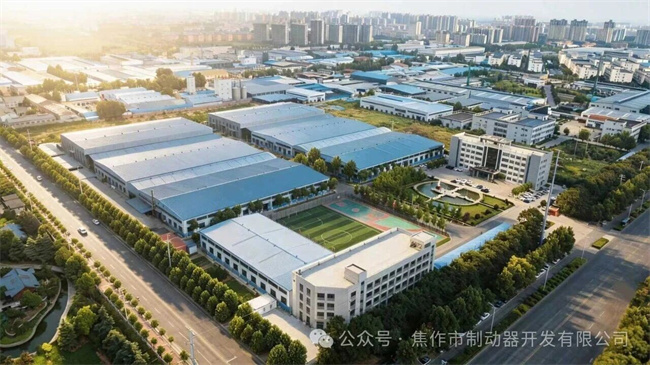
JIAOKAI was founded in 2003 and has been engaged in industrial brakes for more than twenty years. It is a “Specialized, Refined, Distinctive and Innovative” Little Giant enterprise certified by the Ministry of Industry and Information Technology and a Henan Province Manufacturing Single Champion. The company holds more than 50 independent intellectual property rights, including 14 invention patents, and has taken part as a main drafting organization in the formulation of 2 national standards and 3 industry standards.
These qualifications are often written in the first paragraph of a company profile, but their real significance lies further on. Taking part in standard drafting means a company must give answers that peers can test to questions such as “under what operating conditions, how much braking force is required, how quickly must it stop, and what is the fallback when it fails.” The result of doing this over the long term is that JIAOKAI can break down “under what conditions a piece of equipment must stop” into designable parameters, instead of relying on repeated trial and error based on the experience of veteran masters.
Today, what JIAOKAI provides is a complete chain from selection consulting and complete-set design to delivery, operation and maintenance, covering seven fields: wind power generation, ports and offshore engineering, water conservancy and power, metallurgy and mining, lifting machinery, land and air equipment, and construction and road-bridge engineering.
Seven fields sounds like a slogan, but it actually means seven different sets of physical conditions. Wind power faces vibration, variable loads, and unattended operation at heights of a hundred meters; ports and offshore engineering face salt fog, moisture, and year-round continuous operation; metallurgy and mining face dust, high temperature, and overload impact; water conservancy and power face reliability after long periods of low-frequency operation; lifting machinery faces friction component life under frequent inching; and land and air equipment and construction and road-bridge engineering each have their own requirements for size, response, and extreme temperatures. The same braking principle, applied in different scenarios, requires the friction material, heat dissipation structure, sealing method, and redundancy design to all be redone. Whether a company can handle all seven tests its understanding of operating conditions, not just its machining capability.
In wind power, JIAOKAI’s products already support OEMs such as Siemens Gamesa, Goldwind, Envision Energy, Mingyang Smart Energy, Sany Renewable Energy, Windey, Dongfang Electric, CSSC Haizhuang, and CRRC, with multiple product series exported to European and American markets. Facing heavy-load, high-frequency, high-humidity, and high-salt-fog conditions, JIAOKAI continues to iterate on friction materials, heat dissipation structures, and sealing systems, and some key products adopt dual-channel braking and fail-safe designs.
The point of dual channels is that when one braking circuit fails, the other can still complete the braking action independently; fail-safe design turns “power loss,” the most common abnormality, into a safe state in which the brake automatically engages rather than releases. Such designs do not improve performance during normal operation and only work in those few minutes when something goes wrong. Most safety redundancy in industrial equipment exists in this way: invisible in normal times, but once used, it is the only line of defense.
What Customers Ask About Is Operating Conditions
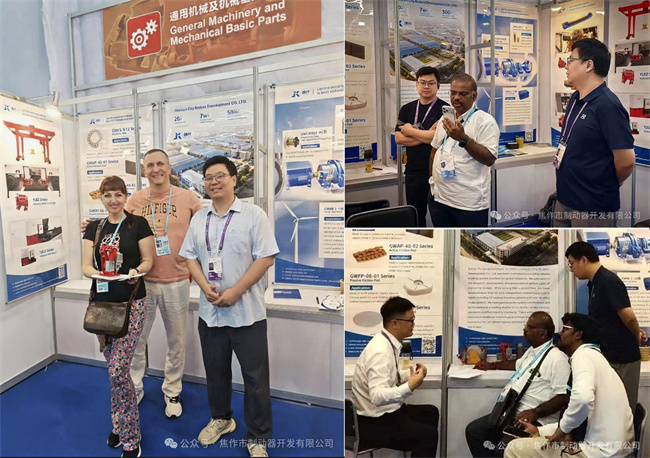
Over the three days of the fair, the questions raised at JIAOKAI’s booth were very specific, and almost nobody asked about price first.
Wind power customers care about certification. For wind power braking components to enter different regional markets, they must meet the entry requirements and certification systems of local OEMs, and a product that runs well in China cannot necessarily pass directly through the certification path of another market. What the JIAOKAI team has to do is map the certification requirements to the product structure item by item, explaining which can be met by existing designs and which need to be adjusted by project.
Port machinery customers care about corrosion protection and sealing. Quay cranes and yard cranes work year-round in high-salt-fog environments, and rust on braking components is not just a cosmetic problem; it changes the condition of the friction surface and thus affects the stability of braking force. How the sealing structure is designed, how long the maintenance cycle is, and whether replacement parts can be changed on site are the numbers procurement managers are really calculating.
Mining equipment customers care about thermal fade. For equipment such as hoists and downhill belt conveyors, which operate continuously and brake frequently, the friction surface temperature rises quickly and braking force falls accordingly. Resistance to thermal fade depends on the friction material formulation and the heat dissipation structure design, both of which directly affect cost and service life. Customers usually bring their own operating data and ask: under my operating conditions, how long can your solution last?
Another group of customers care about replacement. A large amount of in-service equipment has original spare parts that are discontinued or have excessively long lead times; the whole machine cannot be shut down, so replaceable braking components must be found. This kind of demand most tests a company’s drawing capability and response speed—if any one of the interface dimensions, installation space, or braking force curve does not match, installing it creates a hidden hazard.
These questions have no standard answers; the answers depend on the customer’s equipment model, running hours, environmental corrosion grade, and maintenance rhythm. JIAOKAI’s approach is to first clarify the operating parameters, then combine a solution from its product system for the seven major scenarios, giving a preliminary path for selection, delivery, and operation and maintenance on site. Several groups of customers then entered dedicated negotiations, with the topic shifting from viewing sample machines to checking a complete technical solution.
Complete-machine engineers, procurement managers, and engineering contractors from Europe, the Middle East, Southeast Asia, Latin America, and other regions made up the main visitor flow at the booth over the three days. What overseas buyers care about is often not the most attractive line on the parameter sheet but whether the solution can run at their own site and who takes responsibility when problems arise. This is also the biggest difference between industrial goods and consumer goods going global: the former builds trust through delivery after delivery, the latter builds awareness through exposure after exposure.
Three Years, Three Steps: From Debut to Being Tested
Looking back at these three appearances, the rhythm is clear.
The 138th session was the international debut, mainly about “being seen.” For a component company that had long served domestic OEMs, standing before international buyers for the first time meant first letting them know that a Chinese company could make braking components at this level.
At the 139th session, the braking components earned practical feedback from buyers. Feedback is often not an order but more specific questions: how does your part perform on my equipment, how does it differ from the previous supplier, and how soon can you get to the site if something goes wrong. The value of these questions is that they turned the company’s direction of improvement from internal judgment into external testing.
At the 140th session, JIAOKAI showed complete capability adapted to seven major heavy-duty scenarios. The booth no longer displayed individual components in a row but solution combinations organized by scenario. The core of this path is not a bigger booth, but that the starting point of product iteration has moved from the drawing board to the operating site—first knowing where the equipment is, how it is used, and what failures will occur, and then deciding how to formulate the friction material and how to modify the structure.
The value of a brake is hard to explain fully at an exhibition booth. It is reflected in the moment when a load does not slip down as the hook hovers, in the moment when a downhill belt conveyor does not reverse after stopping under full load, in the moment when the nacelle holds steadily to the wind direction after the turbine yaws into position, and also in the moment when, after an old machine is fitted with new braking parts, the operator dares to work as usual. These moments have no audience, but they determine whether the whole production line can stop safely.
This is exactly what the Canton Fair means to JIAOKAI: handing the capabilities honed in real scenarios to global buyers for face-to-face testing. Three appearances are not repeated debuts but a way of connecting Chinese-made braking solutions to real industrial sites again and again. Industrial safety has never been supported by an attractive parameter; it relies on stopping every time it should stop.

Exhibition Preview:
2026 China International Exhibition for Construction Machinery, Building Material Machines, Mining Machines, Engineering Vehicles and Equipment (bauma CHINA 2026)
Time: November 23–26, 2026
Venue: Shanghai World Expo Exhibition & Convention Center
JIAOKAI Booth: H3.115 (2nd Floor)
Business Hotline: 0391-7268868
After-Sales Hotline: 0391-7268818
Business Email: sales@jzzdq.com
Customers old and new are warmly invited to visit our booth and explore innovative heavy-duty braking solutions together.
- Prev:
Jiaozuo City Brakes Development Co., Ltd.
2024-11-11 - Next:
CWP 2026 On Site: JIAOKAI Displays Its Entire Wind Power Braking Product Line at Once
2026-10-30
 Online
 0086-15139173393