CWP 2026 On Site: JIAOKAI Displays Its Entire Wind Power Braking Product Line at Once
2026
WIND POWER INDUSTRY-WIDE BRAKING SYSTEM SOLUTIONS PROVIDER
Beijing International Wind Energy Conference & Exhibition
Jiaozuo City Brakes Development Co.,Ltd.
Beijing · China
Brief Content /BRIEF CONTENT
In golden October, the wind rises in Beijing. From October 14 to 16, the 2026 Beijing International Wind Energy Conference & Exhibition (CWP 2026) was held at the China International Exhibition Center (Shunyi Hall) in Beijing, China. Jiaozuo City Brakes Development Co.,Ltd. (“JIAOKAI” for short) appeared at the exhibition with its wind power braking products and supporting solutions.
An Industry Appointment
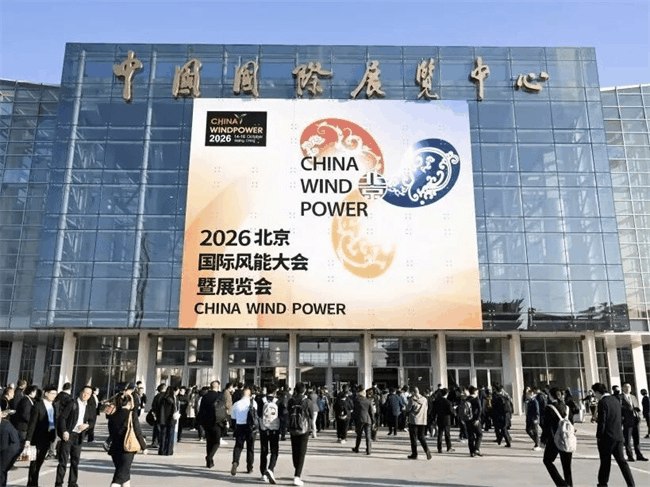
CWP 2026, themed “Promoting High-Quality Collaborative Development and Leading Green and Low-Carbon Transformation,” gathered senior representatives of global wind power industry chain companies, research institutes, and international organizations. The exhibition area exceeded 100,000 square meters, with more than 1,000 exhibitors and 120,000 professional visitors from over 50 countries and regions, making it one of the largest and most influential professional exhibitions in the global wind power sector.
The weight of the conference comes from where the industry stands. 2026 is the first year of the “15th Five-Year Plan”; cumulative grid-connected offshore wind capacity is to reach more than 100 million kilowatts, and total wind and solar installed capacity is to reach more than 2.8 billion kilowatts by 2030. Industry estimates suggest that during the “15th Five-Year Plan” period, annual new wind installations must stay at around 120 million kilowatts, a whole tier above the annual average of the “14th Five-Year Plan.” As installations rise, turbines rise with them—in 2025, the average single-unit capacity of newly installed wind turbines nationwide reached 7,160 kW, up 18% year on year, with 7,068 kW onshore and 10,095 kW offshore. Multi-megawatt models becoming mainstream means every component of the drivetrain must answer the same question anew: with greater loads and longer maintenance intervals, can you still hold up? By writing “expanding volume and improving quality, reliable substitution” into its theme, this conference points exactly at this matter.
Five Linked Stands: Braking Systems, Related Product Lines, and Aftermarket Services
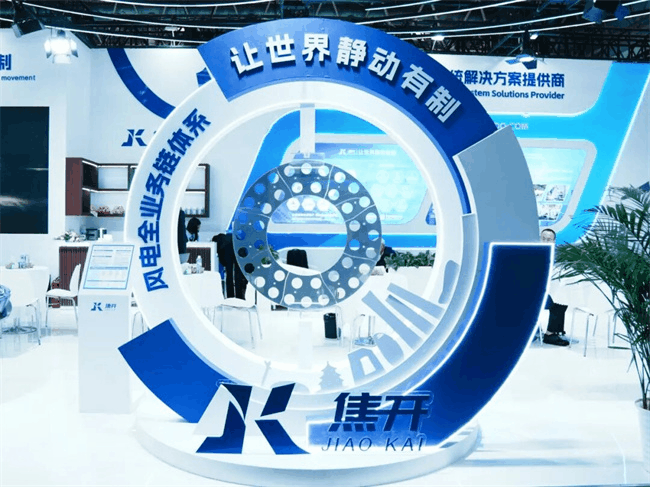
Braking systems account for a small share of a turbine’s cost, but their position is special. They do not take part in power generation and only come on stage at two moments: when a stop is needed, and when safety is needed. In a format of “physical display + scenario demonstration + interactive experience,” JIAOKAI presented its products and supporting solutions for the wind power sector. The five stands each had a different focus and a different nature: one is the brake system itself, two are supporting and key components, one is a technical extension, and one is service after sale. Visitors came in a continuous stream.
01 Brake Turntable: The Core of the Wind Power Braking System
Displayed series of main shaft, yaw, and high-speed shaft brakes and hydraulic locking pins, covering multiple turbine models and operating conditions.
A wind turbine has three braking positions, each handling a different job. The main shaft brake stops the entire machine and must hold back enormous inertia while the rotor is still turning; the yaw brake keeps the nacelle facing the wind, operating frequently and spending long periods in micro-movement, which tests wear resistance and stability; the high-speed shaft brake guards the end of the drivetrain as the last safeguard in emergency conditions and requires millisecond-level response. The hydraulic locking pin provides mechanical locking during maintenance, turning “stopped” into “locked” so that maintenance personnel can safely enter the turbine. The three positions differ completely in force conditions, actuation frequency, and consequences of failure; putting them on one turntable shows how one set of technology adapts to different operating conditions. Visitors could examine the product structure, braking principles, and supporting solutions up close.
02 Coupling Turntable: Adjacent Components in the Same Drivetrain
Couplings and high-speed shaft brakes were displayed in combination, visually showing how two adjacent drivetrain components work together.
A coupling is a drivetrain component and does not itself belong to the braking system. It transmits torque and compensates for deviations in installation and operation; the high-speed shaft brake stops the rotation when needed. The two are adjacent at the end of the drivetrain—one in motion, one stopping—and their response characteristics must match: if the coupling is too flexible, braking shock is transmitted to the gearbox; if the brake cannot respond fast enough, emergency stopping loses its meaning. Demonstrating the two together is about the cooperation between adjacent components, not counting them as one system.
03 Friction-Enhancing Shim Stand: Hardcore Friction Check-In
Diamond friction-enhancing shims were shown through interactive check-ins, letting visitors feel the material’s performance by hand.
JIAOKAI’s diamond friction-enhancing shim uses spring steel as the substrate, coated with a nickel layer and embedded with diamond particles to form a unique micro-form fit. Its friction coefficient can exceed 0.6, about 2–3 times that of conventional friction surfaces. It is resistant to water, oil, and corrosion, and combines lightweight compactness, high load and peak torque capacity, resistance to fretting wear, and long life, with customizable geometries. The product has been widely verified in wind and hydro generators, general mechanical engineering, marine engineering, automobiles, machine tools, aerospace, and other fields, providing an efficient and reliable friction-enhancement solution for equipment upgrades.
04 Electromagnetic Brake Stand: Technology Extension Beyond Wind Power
Electromagnetic brake products and control solutions were displayed, drawing many professional visitors to stop and talk.
Electromagnetic brakes are driven by electromagnetic force and brake when power is cut; they are compact with direct response and widely used in wind power, cranes, port machinery, automated production lines, and other scenarios. By bringing this product line to a wind power exhibition, JIAOKAI shows that its accumulation in braking technology serves more than one industry—and that wind power’s demands on reliability in turn raise the design standards of products in other scenarios. For visiting OEMs and engineering customers, this means a fuller technology spectrum from the same supplier.
05 Aftermarket Display Cabinet: The Stage After the Product Is Sold
Spare parts for operation and maintenance such as brake pads, seals, and coupling accessories were displayed together, making one-stop selection and purchasing convenient for customers.
The value of this stand only truly appears after the turbines are installed. Wind farms are dispersed and remote, and the cost of one shutdown for maintenance is far higher than the spare parts themselves—downtime losses are counted by the hour, and lifting and labor costs are considerable. Whether spare parts arrive in time, whether the models match, and whether batch quality is stable directly affect power generation. JIAOKAI displayed wear parts such as brake pads, seals, and coupling accessories together to show its service capability from new-turbine supply to aftermarket O&M, so customers can complete selection and purchasing at one booth and skip repeated coordination.
Taken together, the five stands covered the main product directions of JIAOKAI in wind power braking and the supporting O&M services extended around them. At a single booth, visitors could get a rough picture of this company’s product landscape.
On Site: Detailed Questions, Deep Conversations
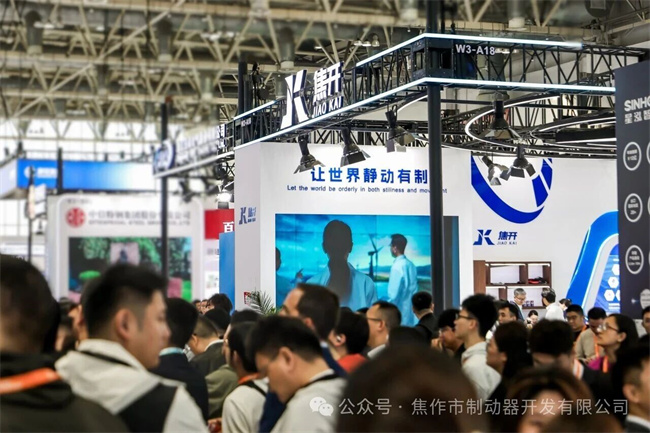
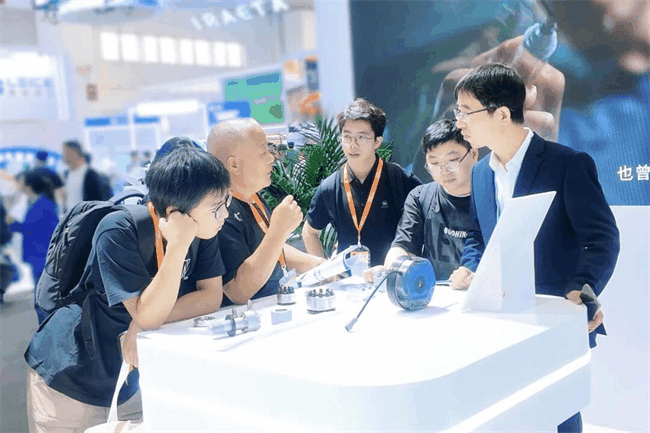
During the exhibition, JIAOKAI’s stand was crowded, with industry customers and professional visitors coming for consultation and negotiation in a continuous stream. Faces from wind turbine OEMs, wind farm operators, international buyers, and industry technical experts were everywhere, and customers showed strong interest in the wind power braking devices and high-performance friction materials displayed by JIAOKAI.
The on-site team held in-depth exchanges with visiting customers on topics such as braking needs for multi-megawatt turbines, anti-corrosion and anti-salt-fog solutions for offshore wind power braking systems, and brake O&M and parts replacement at wind farms. Several groups of customers reached preliminary cooperation intentions on site.
These three topics correspond exactly to the three most practical questions the industry faces right now. As turbine capacity rises, brakes must have their torque and heat dissipation recalculated; as wind farms move from land to far offshore, salt fog, humidity, and temperature differences are long-term tests for metal and friction parts; as the installed base enters the maintenance cycle, spare parts supply and replacement efficiency begin to affect power generation. The enthusiasm at the stand comes from more than twenty years of technical accumulation by the company, and also from reputation built up bit by bit in the industry.
Heading into the Wind: Guarding Global Wind Power Safety with Chinese Braking
From the foot of the Taihang Mountains to global markets, JIAOKAI has come to where it is today step by step. The company has successively won honors including being certified by the Ministry of Industry and Information Technology as a “Specialized, Refined, Distinctive and Innovative” Little Giant enterprise and a Henan Province Manufacturing Single Champion, and its products have passed compliance certifications such as DNV.GL, CCS, and CE.
Wind power equipment faces a service life of twenty years, and the braking system is a link that must not fail. Domestic braking components have taken many years to go from following standards to participating in standards and supporting OEMs. Looking ahead to the new journey of expanding volume and improving quality in wind power during the “15th Five-Year Plan,” JIAOKAI will continue to be driven by technological innovation, cultivate wind power braking technology in depth, and, together with industry chain partners, contribute its share to the high-quality development of the global wind power industry.
 Online
 0086-15139173393